


Could anything be more wonderful than combining traditional woodworking with the joy of music by crafting your own speakers that invite the orchestra to play right in your living room? That exhilarating moment ignited a spark—a young enthusiast encountered the Crevasse speakers at the Radisson SAS hotel’s Hi-Fi expo in the early 2000s and vowed they’d own them someday. Now the dream has come true.

DIY-Crevasse – Creators: Eetu Pakarinen and Esa Lehikoinen
At the turn of 1998–1999, the Crystal Illusion speakers were introduced for the first time in issue 3/1999 of Hifi magazine as well as at industry trade shows. In 2002, the model was updated and renamed Crevasse, and at the early 2000s Hi-Fi shows came a personal revelation: one day, these speakers must be mine. However, the high price tag tempered the enthusiasm of a young hobbyist, and the dream did not come true at that time. Sadly, Crevasse’s representative, Lutz Reinhardt, passed away in 2009, after which production was discontinued. The original mechanical design was carried out by Jontte Knif and Martin Kantola.


The project began by examining why and how the original speaker design was conceived and whether there was room for improvement. The aim was not to replicate the original solution, but to develop it further from our own starting points. We deliberately avoided the easiest fixes and sought a cohesive result that would satisfy both sonically and visually. Thanks to Jontte Knif, who in the project’s early phase illuminated the concept behind the Crevasse speaker and helped clarify the design philosophy underpinning it.


First, prototype versions of the speakers were built to critically evaluate the structural, visual, and technical solutions. At the same time, we tested several different ribbon-tweeter material options. Ribbon materials were literally hunted down around the world, and dozens of prototype ribbons were produced until we found the right combination of weight, impedance, and internal damping—that is, the material’s ability to suppress unwanted after-sounding and resonances. The final ribbon weighed just under one gram per meter, and its impedance, combined with the crossover, settled at around 4 ohms.
Choosing and sourcing the bass drivers also gave the builders headaches, since the bar was set high and no compromises were acceptable for dipole woofers. The Peerless SLS is a commonly used choice in dipole configurations, but we wanted to explore whether better or less conventional options existed. Gradient offered SLS drivers converted for dipole use, but availability and lead times were uncertain. In the end, we decided to order handcrafted Acoustic Elegance Dipole 12″ drivers, which are engineered specifically for dipole operation from a technical standpoint. Their sensitivity matched the ribbon tweeter’s level directly, so no resistors were needed in the crossover for level control. This allowed the crossover design to be kept as simple as possible for both the woofer and the ribbon tweeter.


3D-modeled speakers.
Using prototypes, both the structural and visual solutions were refined, and they were modeled into a precise 3D model that was used in the construction of the final speakers.
The choice of enclosure material also demanded careful consideration, since a painted finish was out of the question. Fortunately, while combing through Hollolan Viilu ja Laminaatti Oy’s stocks, we came across a batch of pre-cut African ebony veneer that proved visually perfect. To showcase all the rich tones of this beautiful wood, the enclosures were finished with nine coats of clear lacquer. The bass enclosure baffles, meanwhile, were clad in a nanolaminate that delivers a matte yet exceptionally durable surface. Even the smallest details received attention: the fabric grilles attach via magnets concealed beneath the surface material, ensuring an exceptionally clean, refined look.


The speaker’s design was also optimized for transport, given its roughly 80 kg weight and large dimensions. Special attention was therefore paid to handling: the upper waveguide section can be quickly detached using thumb screws and snap-in connectors, making disassembly and reassembly—whether for relocation or maintenance—effortless.


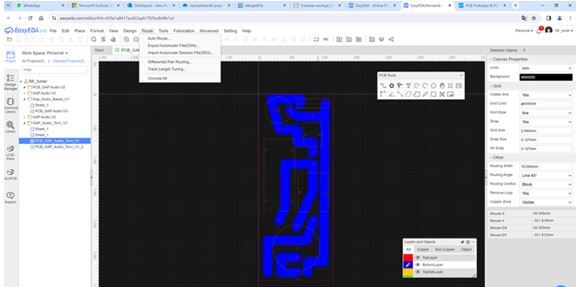
The crossovers were built on a PCB, and the ribbon tweeter crossover used Mundorf air-core inductors and Jantzen 400 V film capacitors. On the bass side, due to limited space, Mundorf iron-core inductors and NP electrolytic capacitors were utilized.



When the waveguides had been glued, transport and painting supports were built for them. Temporary flanges were machined from plywood and secured to the ends of the waveguides with hex bolts into glued-in threaded inserts. A pine batten was passed through the end flanges and locked in place with wooden dowels at both ends. The painting support served as a frame on trestles for intermediate sanding and also kept the pieces upright in their drying rack until the waveguides were fully assembled.


Additionally, the speakers were outfitted with stylish brass terminal plates, transport-tailored protective bags, and dedicated storage cases for the ribbon tweeter’s ribbons. The ribbon tweeter’s crossover was integrated into the waveguide, keeping the bass enclosure clean and compact without any external components.


The project took us roughly two years from start to finish, and what better way to cap it off than by showcasing the speakers in the DIY room for hi-fi enthusiasts at Helsinki Highend 2025 – to the delight of the audience and like-minded builders. Read more about the show.
Two pairs of speakers were completed as a tribute to the original Crevasse design – intentionally a one-off project. Yet the ribbon tweeters and dipole woofers have become a permanent part of the speaker-building core, and new ideas are already taking shape around them, which you can follow on this website’s Projects section. Read also the article by Hifimaailma 5/2006, available in the magazine or online.


